The process to buy property in Dubai is relatively structured, but a successful purchase starts long before the ownership transfer takes place.
Buyers need to decide whether they want a home or investment, calculate the real acquisition budget, choose between ready and off-plan property, verify the broker and property, understand financing, review the sale agreement and complete registration correctly with Dubai Land Department (DLD).
Foreign buyers can participate in the market too. The UAE Government confirms that expatriate residents and foreigners who do not live in the UAE may acquire freehold ownership in areas designated for foreign ownership in Dubai, as well as qualifying usufruct or leasehold rights of up to 99 years.
For completed properties, DLD currently allows a valid passport to be used as identification by a non-resident foreign purchaser during sale registration.
This guide explains the buying process from initial budgeting to receiving the electronic title deed, while also showing where the process changes for off-plan purchases.
How to Buy Property in Dubai at a Glance
For a typical completed-property purchase, the process can be understood in these stages:
- Establish your purpose and budget.
- Arrange mortgage pre-approval if financing is required.
- Choose a suitable Dubai community and property type.
- Work with a properly licensed real estate broker.
- Inspect and verify the property.
- Agree the price and transaction terms.
- Sign the sale agreement.
- Complete any financing and valuation requirements.
- Obtain the developer’s required e-NOC for a freehold resale.
- Complete the ownership transfer through a Real Estate Registration Trustee.
- Pay the applicable DLD and transaction fees.
- Receive the electronic title deed.
DLD’s current completed-property sale-registration procedure confirms that transactions can be processed through Real Estate Registration Trustee centres, where documents are checked, transaction information is audited, fees are paid and the resulting documents are issued electronically.
The details become more important at each stage.
Step 1: Decide Why You Are Buying
Before searching listings, decide what the property is supposed to achieve.
A buyer looking for a primary residence should not necessarily evaluate property in the same way as an investor.
Buying a home
An owner-occupier may prioritise:
- commute
- schools
- property size
- community facilities
- parking
- privacy
- layout
- future family needs
- accessibility
- long-term affordability
Buying an investment property
An investor should pay greater attention to:
- purchase price
- achievable rent
- service charges
- vacancy risk
- maintenance
- tenant demand
- future competing supply
- property management
- resale liquidity
- exit strategy
Establishing the purpose before choosing the property prevents a common mistake: finding an attractive property first and then trying to create an investment case around it.
Step 2: Calculate Your Full Property Budget
The advertised property price is not the complete cost of buying in Dubai.
Your budget should account for the purchase price plus applicable registration, trustee, financing and ownership expenses.
DLD’s current Property Sale Registration schedule lists a combined registration charge equal to 4% of the sale value, formally divided into 2% for the seller and 2% for the buyer. Additional official charges apply for the title deed, maps and Registration Trustee service.
Current DLD sale-registration costs
| Cost | DLD-listed amount |
|---|---|
| Seller registration charge | 2% of sale value |
| Buyer registration charge | 2% of sale value |
| Combined registration charges | 4% of sale value |
| Title deed certificate | AED250 |
| Unified map under Dubai Municipality | AED225 |
| Map for land outside Dubai Municipality | AED100 |
| Villas and apartments map fee | AED250 |
| Knowledge fee | AED10 |
| Innovation fee | AED10 |
| Trustee fee if sale value is AED500,000 or more | AED4,000 + VAT |
| Trustee fee if sale value is below AED500,000 | AED2,000 + VAT |
These are the current amounts published by Dubai Land Department for its Property Sale Registration service.
Other transaction-specific expenses may include brokerage, mortgage processing, valuation, insurance, conveyancing or legal advice.
Because these charges are not identical for every transaction, obtain an itemised cost estimate before committing to the purchase.
Keep a cash reserve
Do not put every available dirham into the acquisition.
Property ownership can produce additional expenses after purchase, including maintenance, furnishing, service charges and periods without rental income if the property is an investment.
Step 3: Decide Whether You Need a Mortgage
Buyers who require financing should investigate mortgage eligibility before becoming contractually committed to a property.
This is particularly important because the amount a buyer is willing to pay is not necessarily the amount a bank will value or finance.
The Central Bank of the UAE regulates residential mortgage lending through loan-to-value limits and other lending requirements. It also sets a maximum LTV of 50% for mortgages on off-plan property, regardless of the purpose, value or purchaser category.
Actual mortgage approval can still depend on the lender’s assessment of factors such as income, liabilities, creditworthiness, property valuation and the property being financed.
Why mortgage pre-approval matters
Pre-approval can help a buyer understand:
- the approximate borrowing capacity
- expected cash deposit
- likely monthly repayments
- financing costs
- the price range that is realistically affordable
It also reduces the risk of negotiating for a property that ultimately cannot be financed on acceptable terms.
Do not confuse the bank valuation with the asking price
A bank may value a property differently from the agreed purchase price.
If the valuation comes in below the agreed price, the buyer may need to contribute additional cash.
Financial planning should therefore include some margin rather than assuming the lender will finance the property based entirely on the negotiated price.
Step 4: Confirm That You Can Own the Property
Foreign property ownership in Dubai is permitted within designated areas.
The UAE Government states that foreigners and expatriate residents may acquire freehold ownership in designated Dubai freehold areas. They may also acquire usufruct or qualifying leasehold rights for periods of up to 99 years.
Freehold ownership
Freehold generally provides registered ownership of the qualifying property interest.
For international buyers, this is the structure most commonly associated with Dubai’s designated foreign-ownership communities.
Leasehold and usufruct
Other ownership arrangements may provide rights to use or occupy a property for a specified period rather than unrestricted freehold ownership.
Buyers should therefore confirm the exact legal interest being acquired rather than simply asking whether a property is “for sale.”
Step 5: Choose the Right Dubai Area
Do not select a community only because it is popular online.
The right location should match the reason for purchasing.
A family home, short-term lifestyle property and long-term rental investment require different location criteria.
For an investment property
Consider:
- tenant profile
- employment access
- transport
- existing rental demand
- future supply
- service charges
- property type
- resale market
For your own home
Consider:
- commute
- schools
- healthcare
- retail
- public spaces
- property size
- road connections
- long-term suitability
The better question is not “What is the best area in Dubai?”
It is “Which area best supports what I need this property to do?”
Step 6: Use a Licensed Dubai Real Estate Broker
A broker can help identify properties, negotiate with sellers and coordinate the transaction, but buyers should verify the broker’s status independently.
Dubai Land Department maintains an official Licensed Real Estate Brokers service through which users can check registered brokers and their brokerage details.
Do this before transferring money or relying on the broker for a significant transaction.
What a good broker should help you understand
The broker should be able to explain:
- asking price
- recent comparable properties
- seller circumstances where relevant
- property status
- service charges
- transaction steps
- expected documentation
- developer requirements
- key deadlines
A broker’s role does not replace the buyer’s own due diligence.
Step 7: View and Inspect the Property
For a completed property, a physical inspection is one of the major advantages over buying off-plan.
Do not assess only the interior decoration.
Look at the complete asset.
Inside the property
Check:
- walls and ceilings
- flooring
- windows
- bathrooms
- kitchen fittings
- storage
- balconies
- air-conditioning
- plumbing
- electrical fittings
- signs of moisture or poor maintenance
Inside the building
Check:
- entrance
- lifts
- corridors
- parking
- common areas
- maintenance condition
- facilities
- building management
Outside the building
Consider:
- nearby construction
- traffic
- road access
- noise
- surrounding plots
- retail access
- public transport
- neighbouring developments
For an expensive or older property, an independent professional inspection can provide additional reassurance.
Step 8: Verify the Property Before Paying
Never rely exclusively on a document provided by a seller or intermediary when an official verification tool is available.
Dubai Land Department provides a Verify Title Deed service that allows customers to check the validity of title documentation and validate property information.
DLD also provides a Property Status Enquiry service through which a customer can investigate property status using property information such as the area and land number.
Verify the title
Confirm that the title information corresponds with the property being offered.
Check the property status
Use official DLD services where appropriate rather than depending solely on screenshots, PDFs or forwarded documents.
Check service charges
For jointly owned properties, DLD provides a Service Charge Index allowing users to enquire about service charges approved by RERA.
Service charges matter particularly for investors because they directly affect net rental return.
Step 9: Make an Offer and Agree the Commercial Terms
Once due diligence has reached an acceptable stage, the buyer can negotiate the purchase.
Price is only one part of the negotiation.
Important terms may include:
- agreed sale price
- deposit
- completion deadline
- mortgage conditions
- existing mortgage settlement
- furniture or appliances included
- vacant-possession arrangements
- outstanding obligations
- transaction expenses
- consequences of default
Avoid relying on verbal promises.
Anything important to the transaction should be reflected properly in the contractual documentation.
Step 10: Sign the Sale Agreement
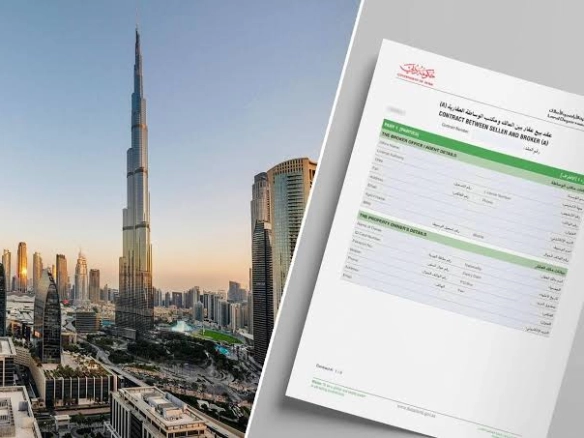
For resale transactions involving a broker, buyers will commonly encounter the DLD/RERA sale contract generally known as Contract F or Form F.
DLD maintains an official Contract F system. The contract captures information about the owner, buyer, property, mortgage and commission arrangements.
Dubai Land Department also publishes a Real Estate Sale Agreement Template through its official website.
Read the agreement before signing
Check:
- buyer and seller names
- property details
- sale price
- deposit arrangements
- transfer deadline
- financing conditions
- included items
- default provisions
- commission
- additional agreed terms
Do not assume every contract is identical simply because a standard form is involved.
Transaction-specific terms still matter.
Do buyers always pay a 10% deposit?
A percentage frequently quoted in the Dubai resale market should not be treated as a universal legal rule for every transaction.
The amount, treatment and consequences of the deposit should be confirmed in the actual sale agreement.
That is more reliable than assuming that a generic market practice automatically applies to your purchase.
Step 11: Complete Mortgage Valuation and Final Approval
If you are financing the property, the bank will normally need to complete its own property and borrower assessment before finalising the mortgage.
The exact procedure depends on the lender.
The buyer should avoid treating initial pre-approval as unconditional final approval.
Changes involving:
- property valuation
- employment
- debt
- income
- credit circumstances
- bank policy
can potentially affect the amount or conditions of financing.
Maintain communication with the lender throughout the transaction.
Step 12: Obtain the Developer’s NOC for a Ready Property
For completed property transactions in Dubai freehold areas, DLD’s current registration requirements include a developer-issued electronic no-objection certificate, or e-NOC, accessed through the Dubai REST system.
The NOC stage is therefore an important part of preparing a resale property for transfer.
Buyers should confirm that any required developer conditions and outstanding property-related matters have been addressed before proceeding to final ownership registration.
Step 13: Complete the Property Transfer With DLD
The ownership transfer is the stage where the transaction becomes officially registered.
DLD’s current Property Sale Registration process for completed properties operates through Real Estate Registration Trustee centres.
The official process includes:
- Submitting the required documents to the Registration Trustee.
- Verification of the documents.
- Entry and audit of the transaction information.
- Payment of applicable fees.
- Electronic issuance of the transaction documents.
Documents for individual buyers and sellers
DLD currently lists:
- Emirates ID of the seller and buyer for identity verification; or
- a valid passport for a non-resident foreign buyer; and
- an electronic NOC from the developer for applicable properties in freehold areas.
Additional requirements can apply to companies, representatives, mortgaged properties and other transaction structures.
Step 14: Receive the Electronic Title Deed
Once the transfer has been successfully registered, DLD lists an Electronic Title Deed among the documents issued through the Property Sale Registration service.
This is a critical document proving the registered ownership interest.
The buyer should retain:
- title deed
- sale agreement
- payment records
- DLD receipts
- mortgage documentation
- NOC documentation
- relevant broker and developer records
These documents may later be needed for financing, property management, residency applications or resale.
How the Process Changes When Buying Off-Plan
Buying directly from a developer before the property is completed involves a different registration process.
For off-plan property, the buyer typically signs a Sale and Purchase Agreement with the developer rather than completing an immediate transfer of a completed title deed.
DLD’s current Initial Sale Registration service states that developers register off-plan purchases through the Oqood provisional-sale system.
Off-plan registration
For an individual buyer, DLD lists:
- a copy of the Sale and Purchase Agreement
- UAE ID where applicable
- a valid passport for a non-resident purchaser
as part of the required documentation.
DLD currently requires the Sale and Purchase Agreement to be entered in the provisional register within 90 days of signing. The purchaser receives a provisional registration e-certificate.
Off-plan DLD registration charges
DLD currently lists:
- seller: 2% of sale value
- purchaser: 2% of sale value
- AED10 Knowledge fee
- AED10 Innovation fee
for provisional initial-sale registration.
Off-plan buyers should also verify the project and developer and understand the escrow arrangements, payment schedule, completion provisions and resale restrictions before signing.
Ready Property vs Off-Plan Property
| Factor | Ready Property | Off-Plan Property |
| Construction | Completed | Still under development |
| Inspection | Actual property can normally be viewed | Limited before completion |
| Rental income | Potentially available quickly | Usually begins after completion |
| Payment structure | Purchase normally completed around transfer | Often spread over development |
| Registration | Completed-property title transfer | Provisional registration first |
| Construction risk | Limited | Present |
| Future market uncertainty | Lower | Higher |
| Mortgage availability | Generally broader | More restrictive |
| Handover risk | Usually not relevant | Relevant |
The right choice depends on your finances and objectives rather than on one category being universally better.
Can Foreigners Buy Property in Dubai?
Yes.
The UAE Government states that foreigners who do not live in the UAE and expatriate residents can acquire freehold ownership in areas designated for foreign ownership in Dubai.
DLD’s completed-property registration service also explicitly accepts a valid passport for non-resident foreign purchasers.
This means an overseas buyer does not need to become a UAE resident before purchasing a qualifying Dubai property.
Residency and ownership should nevertheless be treated as separate legal questions.
Can Property Ownership Lead to a Dubai Golden Visa?
Qualifying property ownership can support an application for long-term UAE residency.
Dubai Land Department’s current real estate investor Golden Visa service states that an investor owning property with a purchase value of AED2 million or more can apply for a renewable 10-year residence permit, subject to the applicable requirements.
DLD currently requires an electronic title deed/title deed as part of the application documentation. It also states that mortgaged property may qualify subject to the applicable bank documentation and conditions.
Do not purchase solely on the assumption that the visa will automatically be granted.
If residency is an important reason for the purchase, verify the current requirements before becoming contractually committed.
Dubai First-Time Home Buyer Programme
UAE residents buying their first freehold home in Dubai may also want to check DLD’s First-Time Home Buyer Programme.
As of August 2026, DLD lists four main eligibility conditions:
- UAE resident of any nationality
- does not currently own a freehold residential property in Dubai
- at least 18 years old
- seeking a property valued below AED5 million.
Programme benefits can include priority access to certain launches, preferential prices from participating developers, registration-fee payment options and mortgage benefits through participating banks. The exact offer depends on the participating developer or lender.
Eligible buyers should consider checking the programme before purchasing independently.
How to Check Service Charges Before Buying
Service charges are particularly important when buying apartments or property within jointly owned developments.
DLD’s Service Charge Index allows customers to enquire about approved service fees for jointly owned properties in Dubai.
Dubai REST also provides property-related services and access to the service-charge index.
Why service charges matter
Suppose two apartments both generate AED100,000 in annual rent.
If one carries materially higher annual service charges, its net investment return will be lower even though the headline rent is identical.
Check recurring costs before making an offer rather than treating them as an after-purchase detail.
Questions to Ask Before Buying a Dubai Property
Before signing, make sure you can answer the following:
- Is the property available for my intended ownership structure?
- Is the broker properly licensed?
- Have I verified the title or project through official channels?
- What is the total cost beyond the advertised price?
- What are the annual service charges?
- If tenanted, what are the existing tenancy terms?
- Is the property mortgaged?
- Do I require mortgage finance?
- What happens if financing is delayed or declined?
- What exactly does the sale agreement require?
- What are the transfer deadlines?
- What is included with the property?
- If buying as an investment, what is the realistic net return?
- If buying off-plan, is the transaction properly registered?
- What is my long-term exit strategy?
If several of these questions remain unanswered, the buyer probably needs more due diligence before proceeding.
Common Mistakes When Buying Property in Dubai
Focusing only on the asking price
The full acquisition and ownership cost matters more than the listing price.
Not verifying the broker
Use Dubai Land Department’s licensed-broker records.
Not checking the title
DLD provides a dedicated title-deed verification service.
Ignoring service charges
They can materially affect investment returns and long-term ownership cost.
Signing without understanding the contract
Deadlines, deposits, financing clauses and default provisions matter.
Assuming mortgage pre-approval guarantees finance
Final lending remains subject to lender requirements and property assessment.
Buying an investment based only on projected appreciation
Future property prices cannot be guaranteed.
Evaluate rental economics, holding costs and exit liquidity as well.
Choosing off-plan property only because the instalments appear affordable
A long payment plan does not automatically mean a property represents good value.
Compare the total purchase price with realistic alternatives.
Frequently Asked Questions
How do I buy property in Dubai?
Start by establishing your budget, choose a qualifying property, verify the broker and title, agree the transaction terms, sign the sale agreement, complete financing where required, obtain the relevant e-NOC and register the transfer with Dubai Land Department.
Can a foreigner buy property in Dubai?
Yes. Foreign residents and non-residents can own qualifying property in designated Dubai freehold areas.
Do I need UAE residency to buy property in Dubai?
No. DLD’s current Property Sale Registration service accepts a valid passport for a non-resident foreign purchaser.
How much are Dubai Land Department property fees?
For completed-property sale registration, DLD currently lists 2% of the sale value for the seller and 2% for the buyer, plus applicable title deed, map, Knowledge, Innovation and Registration Trustee fees.
What is Form F in Dubai real estate?
Contract F is DLD’s real estate sale contract framework for a resale transaction, containing information relating to the owner, buyer, property, mortgage and commission.
Do I need an NOC to buy a resale property?
DLD currently lists an electronic NOC from the developer among the required documents for completed-property sale registration in freehold areas.
How do I check whether a Dubai title deed is genuine?
Dubai Land Department provides an online Verify Title Deed service for checking the validity of title documentation and associated property information.
What happens after the property transfer?
Once DLD completes the registration process, an electronic title deed is issued. Buyers should then retain the documentation, arrange property management or occupation, account for service charges and complete any other ownership-related arrangements.
Can I buy off-plan property in Dubai?
Yes. Off-plan purchases use DLD’s provisional registration framework. DLD currently requires the SPA to be registered in the provisional register within 90 days of signing.
Can buying Dubai property qualify me for a Golden Visa?
Qualifying property ownership may support an application. DLD currently lists a minimum qualifying purchase value of AED2 million for its 10-year real estate investor Golden Visa service, subject to the applicable requirements.
Making a Safer Dubai Property Purchase
Buying property in Dubai is not simply a matter of finding a listing, negotiating the price and transferring money.
A well-managed purchase starts with preparation.
Define what the property needs to achieve. Establish the total budget. Arrange financing early if necessary. Confirm foreign-ownership eligibility where applicable. Work with a licensed broker. Inspect the property carefully and verify the title through Dubai Land Department.
Then read the sale agreement properly, confirm the applicable NOC and transfer requirements, calculate all costs and complete registration through the authorised DLD process.
For an investment property, go another step further: calculate the potential return after service charges, management, maintenance and vacancy rather than relying on an advertised gross yield.
For off-plan purchases, verify the project, developer, provisional registration and payment obligations before committing capital.
HAMZ International Real Estate can help buyers compare suitable ready and off-plan properties in Dubai, understand the purchasing process and evaluate properties according to their budget, intended use and investment objectives.
Sources & Fact-Checking
Dubai Land Department — Property Sale Registration
Supports: completed-property transfer procedures, buyer identification requirements, developer e-NOC, registration fees, Registration Trustee charges and electronic title-deed issuance.
Direct source URL:
https://dubailand.gov.ae/en/eservices/property-sale-registration/
Dubai Land Department — Licensed Real Estate Brokers
Supports: official verification of brokers licensed to conduct real estate brokerage activities in Dubai.
Direct source URL:
https://dubailand.gov.ae/en/eservices/licensed-real-estate-brokers/licensed-real-estate-brokers-list/
Dubai Land Department — Verify Title Deed
Supports: official verification of Dubai title deeds and property/ownership information.
Direct source URL:
https://dubailand.gov.ae/en/eservices/title-deed-verification-overview/title-deed-verification/
Dubai Land Department — Property Status Enquiry
Supports: official enquiries into the status of a Dubai property using property-related information.
Direct source URL:
https://dubailand.gov.ae/en/eservices/property-status-overview/
Dubai Land Department — Contract F
Supports: official Dubai resale property Contract F framework and buyer, seller, property, mortgage and commission information.
Direct source URL:
https://emart.dubailand.gov.ae/Contracts/ContractFPage.aspx
Dubai Land Department — Real Estate Sale Agreement Template
Supports: official DLD real estate sale agreement documentation.
Direct source URL:
https://dubailand.gov.ae/en/about-dubai-land-department/real-estate-sale-agreement-template/
Dubai Land Department — Initial Sale Registration
Supports: off-plan/Oqood provisional registration, required buyer documents, registration fees, 90-day SPA registration requirement and provisional registration certificate.
Direct source URL:
https://dubailand.gov.ae/en/eservices/request-to-register-the-initial-sale/
Dubai Land Department — Service Charge Index
Supports: RERA-approved service-charge information for jointly owned properties in Dubai.
Direct source URL:
https://dubailand.gov.ae/en/eservices/service-charge-index-overview/
Dubai Land Department — Dubai REST
Supports: digital property services, service-charge information and other property verification and management functions.
Direct source URL:
https://dubailand.gov.ae/en/eservices/dubai-rest/
Dubai Land Department — Golden Visa Application for Real Estate Investors
Supports: AED2 million qualifying property threshold, 10-year renewable residency, title-deed requirement and mortgaged-property conditions.
Direct source URL:
https://dubailand.gov.ae/en/eservices/request-for-golden-visa-investor/
Dubai Land Department — First-Time Home Buyer Programme
Supports: current eligibility criteria and programme benefits for qualifying first-time home buyers in Dubai.
Direct source URL:
https://dubailand.gov.ae/en/eservices/first-time-home-buyer-overview/
UAE Government — Expatriates Buying Property in the UAE
Supports: foreign ownership rights in designated Dubai freehold areas and qualifying usufruct and leasehold rights.
Direct source URL:
https://u.ae/en/information-and-services/moving-to-the-uae/expatriates-buying-a-property-in-the-uae
Central Bank of the UAE — Regulations Regarding Mortgage Loans
Supports: UAE residential mortgage regulations, loan-to-value requirements and the maximum LTV applicable to off-plan property.
Direct source URL:
https://rulebook.centralbank.ae/en/rulebook/regulations-regarding-mortgage-loans
Read Also: Best Areas to Invest in Dubai Real Estate