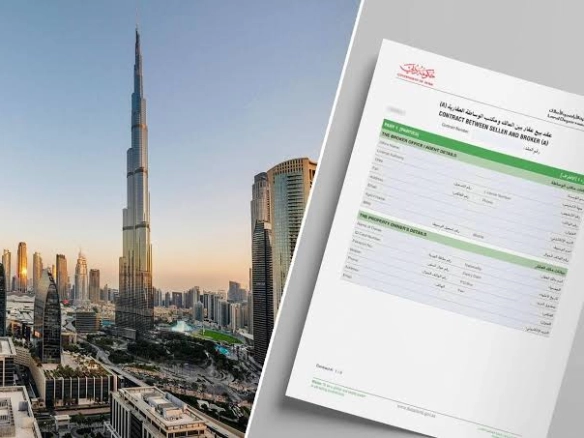

A Dubai property NOC is a No Objection Certificate confirming that the issuing authority has no objection to a proposed property transaction. During a typical resale in a Dubai freehold development, the relevant developer issues the NOC before ownership is transferred to the buyer.
The certificate helps confirm that the transaction can proceed from the developer’s perspective and that identified requirements have been addressed. These may include outstanding service charges, administrative fees or other obligations recorded against the unit.
Dubai Land Department lists an electronic NOC from the developer as a required document for registering sales in freehold areas.
However, a developer NOC is not the only type of NOC used in Dubai real estate. Banks, free-zone authorities, jointly owned property management entities and other competent bodies may issue separate no-objection documents in specific circumstances.
What Does NOC Mean?
NOC stands for No Objection Certificate.
In a property sale, the certificate generally means the issuer does not object to the transaction described in the document. It commonly identifies:
- The property
- The current owner
- The proposed buyer
- The intended transaction
- The issuing entity
- The certificate’s validity period
- Any conditions attached to the approval
The information must match the transaction documents. An incorrect buyer name, unit number or title deed reference can delay the transfer.
Why Is a Dubai Property NOC Important?
The developer’s NOC is an important part of the resale process for properties in freehold developments.
It helps demonstrate that the developer has reviewed the proposed transfer and has not identified an unresolved issue preventing it from providing its approval.
For sellers, the Dubai property NOC helps prepare the unit for transfer. For buyers, it provides an additional confirmation that the transaction has passed an important administrative stage.
The certificate may help identify matters such as:
- Unpaid service charges
- Outstanding developer amounts
- Unresolved administrative fees
- Incorrect ownership information
- Unapproved property alterations
- Missing documents
- Restrictions recorded by the developer
- Differences between the unit records and the proposed transaction
The exact checks depend on the developer, property and type of transaction.
Who Issues an NOC in Dubai Real Estate?
The issuer depends on why the certificate is required.
Developer NOC
For a completed property in a freehold development, the master developer or relevant developer generally issues the NOC required for the resale.
This is the document most people mean when discussing an NOC for a Dubai property transfer.
Bank NOC or mortgage release document
If the property is mortgaged, the seller’s bank must be involved. The transaction may require a liability letter, mortgage release letter or another bank approval document.
A bank document does not replace the developer’s NOC where a developer e-NOC is required.
Off-plan resale NOC
An owner selling an off-plan property before completion may need the developer’s consent to assign the purchase contract to another buyer.
The developer may require the original buyer to have paid a specified portion of the purchase price and to satisfy other conditions under the sale and purchase agreement.
Management-company or jointly owned property NOC
Certain applications affecting a unit or common-property records may require approval from the developer or the relevant jointly owned property management entity.
Free-zone authority NOC
A company registered in a free zone may require an NOC from the relevant authority for certain property-registration transactions.
Other authority approvals
Special transactions can require approval from another competent body. Examples may involve minor owners, court matters, inherited property or restricted ownership structures.
Is an NOC Required for Every Dubai Property Sale?
Dubai Land Department requires an e-NOC from the developer when registering the sale of a property in a freehold area.
However, requirements can differ for:
- Property outside a freehold development
- Mortgaged property
- Off-plan assignments
- Company-owned property
- Court-ordered sales
- Property owned by minors
- Gifts or inheritance transfers
- Usufruct or Musataha transactions
- Units governed by special authorities
The parties should confirm the exact requirements for their transaction with the developer and the relevant Real Estate Registration Trustee Centre.
What Is an e-NOC?
An e-NOC is the electronic version of the developer’s No Objection Certificate.
Dubai’s electronic process allows the certificate to be connected to the official property-registration system. Dubai Land Department states that the developer e-NOC required for a freehold-area sale is available through the Dubai REST process.
An electronic certificate can reduce paperwork and make it easier for the registration trustee to verify the approval.
Sellers should still review the e-NOC details and confirm that it remains valid for the scheduled transfer date.
When Is the NOC Obtained?
For a standard secondary-market transaction, the NOC is generally obtained after the buyer and seller sign Form F.
The typical sequence is:
- The seller appoints a broker through Form A.
- The buyer appoints a broker through Form B where applicable.
- The buyer and seller negotiate the price and conditions.
- The parties approve Form F.
- The buyer provides the agreed deposit.
- The NOC application is submitted.
- The developer reviews the application.
- Outstanding requirements are settled.
- The developer issues the e-NOC.
- The parties complete the ownership transfer.
The exact order can vary, particularly where a mortgage, power of attorney or off-plan assignment is involved.
How to Obtain an NOC for a Dubai Property
The process depends on the developer, but a typical application follows several stages.
1. Confirm the transaction details
The property details, buyer information, selling price and other material terms should be agreed and correctly recorded.
Any difference between Form F, the title deed and the NOC application should be resolved before submission.
2. Check the property account
The seller should ask the developer or management entity for an updated statement of account.
This can reveal service charges, community fees or other amounts that may need to be paid before the NOC is issued.
3. Prepare the documents
The seller, buyer, broker or authorised representative prepares the required identification and transaction documents.
4. Submit the application
The application is submitted through the process specified by the developer. Depending on the development, this may be handled electronically or through an authorised customer service channel.
5. Complete any required checks
Some developers may request additional information, signatures or a property inspection. An inspection is not a universal requirement, so the parties should confirm the procedure for the specific development.
6. Pay the applicable amounts
The seller may need to settle service charges, outstanding developer balances and the applicable NOC administration fee.
7. Receive the e-NOC
Once the requirements are satisfied, the developer issues the certificate. The parties can then proceed with the ownership transfer while it remains valid.
What Documents Are Needed for an NOC?
Requirements vary, but the following documents may be requested:
- Seller’s Emirates ID or passport
- Buyer’s Emirates ID or passport
- Property title deed
- Signed Form F
- Developer application form
- Proof of settled service charges
- Mortgage liability or release documents
- Power of attorney where a representative is acting
- Company documents for a corporate owner or buyer
- Contact details of both parties
- Existing sale and purchase agreement
- Off-plan payment statement where applicable
Joint owners may all be required to approve the application unless a valid representative has authority to act for them.
How Much Does an NOC Cost in Dubai?
There is no single NOC fee that applies to every Dubai property transaction.
The amount can depend on:
- The developer
- The development
- The property type
- The transaction
- Whether additional services are required
- Whether any outstanding amounts must be cleared
The seller should request a written breakdown before applying.
The NOC fee should not be confused with service-charge arrears, developer instalments, mortgage-settlement amounts or Dubai Land Department registration fees. These are separate transaction costs.
Who Pays the NOC Fee?
The seller commonly pays the developer’s NOC fee because the seller must prepare the property for transfer. However, the parties can agree on a different allocation.
Form F should clearly state who will pay:
- The NOC fee
- Outstanding service charges
- Developer administration charges
- Mortgage release expenses
- Dubai Land Department fees
- Trustee charges
- Brokerage commission
Leaving these costs unclear can cause disagreements close to the transfer date.
How Long Does It Take to Get an NOC?
Processing time varies by developer and transaction.
A straightforward application may be completed relatively quickly when:
- The documents are complete
- The property details are correct
- All required owners have approved
- No mortgage complications exist
- Service charges are fully paid
- No property restriction is recorded
An application can take longer if documents are missing, amounts remain unpaid or a bank, court or company authority must be involved.
The parties should avoid scheduling the transfer too tightly around an estimated issue date.
How Long Is a Dubai Property NOC Valid?
An NOC normally has a limited validity period, but the period is not necessarily identical across every developer or transaction.
The expiry date should be checked on the certificate itself. If the transfer does not occur before expiry, the seller may have to request a new NOC, provide updated documents or pay additional charges.
Form F should allow enough time for the NOC, bank and transfer procedures to be completed.
What Happens If the NOC Expires?
An expired NOC may no longer be accepted for the ownership transfer.
The seller should contact the developer immediately to determine whether the certificate can be renewed or whether a fresh application is required.
The buyer and seller may also need to extend Form F if the contractual completion deadline is approaching. Any extension should be documented and approved before the existing agreement expires.
Can a Developer Refuse to Issue an NOC?
A developer may withhold the NOC while legitimate requirements remain unresolved. Common reasons can include:
- Unpaid service charges
- Outstanding purchase instalments
- Missing identification documents
- Inaccurate transaction details
- Unauthorised changes to the property
- Mortgage-related restrictions
- Missing approvals from a joint owner
- An expired or insufficient power of attorney
- A legal restriction recorded against the property
If the application is rejected, the seller should request the reason in writing and determine what must be corrected.
Where the parties believe the NOC is being delayed or refused improperly, they may seek guidance from Dubai Land Department, the relevant regulatory channel or a qualified legal adviser.
How Does an NOC Work for a Mortgaged Property?
Selling a mortgaged property involves more than obtaining the developer’s NOC.
Dubai Land Department’s mortgaged-property sale procedure requires documents such as a liability letter from the bank or a letter from the developer showing the remaining amount. The transaction must account for repayment of the existing debt and release of the mortgage.
A mortgaged sale can involve:
- The seller requesting a liability letter.
- The parties arranging payment of the outstanding debt.
- The bank receiving the required manager’s cheque.
- The bank issuing the mortgage release document.
- The mortgage being removed from the property record.
- The developer NOC being obtained where required.
- The sale and any new buyer mortgage being registered.
The process should be coordinated carefully because bank letters, NOCs and transaction documents may have different expiry dates.
How Does an NOC Work for Off-Plan Property?
An off-plan buyer who wants to sell before completion may require the developer’s approval to transfer or assign the contractual interest.
The developer will normally check:
- Whether resale is permitted
- The percentage of the price already paid
- Whether instalments are up to date
- Whether registration requirements have been satisfied
- Whether an assignment fee applies
- Whether the new buyer meets the developer’s requirements
- Whether the original agreement restricts resale
The rules vary between developers and projects. Buyers should read the sale and purchase agreement before assuming that an off-plan unit can be resold immediately.
Is an NOC the Same as a Service-Charge Clearance Certificate?
Not necessarily.
A service-charge clearance confirms the status of charges associated with the property. A developer may require the account to be cleared before issuing the NOC, but the two documents do not always serve the same purpose.
The NOC addresses the developer’s approval of the proposed transaction. The service-charge statement addresses amounts recorded against the property account.
Is an NOC the Same as a Title Deed?
No. The documents have entirely different purposes.
| Document | Purpose |
|---|---|
| Title deed | Records the registered legal owner of the completed property |
| Form F | Records the agreed resale terms between the buyer and seller |
| Developer NOC | Confirms that the developer has no objection to the proposed transfer |
| Bank liability letter | States the outstanding mortgage amount |
| Mortgage release letter | Supports removal of the existing mortgage |
| Service-charge statement | Shows charges recorded against the property account |
An NOC does not prove that the buyer owns the property. Ownership changes only after the sale is officially registered and the new title deed is issued.
Does an NOC Prove the Property Has No Problems?
No. Buyers should not treat the NOC as a complete property-verification report.
It does not automatically confirm:
- The physical condition of the property
- The absence of construction defects
- The accuracy of the listing
- The property’s market value
- Guaranteed rental income
- Future service-charge levels
- Mortgage approval
- Vacant possession
- The absence of every possible legal issue
Buyers should still verify the title deed, inspect the property, review the service charges and check the tenancy status before completing the purchase.
What Should Buyers Check on the NOC?
Before transfer, the buyer should confirm:
- The developer issued the certificate
- The property details are correct
- The seller’s name matches the title deed
- The buyer’s details are accurate
- The transaction type is correct
- The certificate remains valid
- No unexpected condition appears
- Any mortgage requirements are being handled separately
A mistake should be corrected before the parties attend the transfer appointment.
What Should Sellers Do Before Applying?
Sellers can reduce delays by:
- Requesting an updated account statement early
- Settling valid outstanding service charges
- Checking the title deed information
- Confirming the mortgage balance
- Preparing all owners’ identification documents
- Reviewing the power of attorney where applicable
- Checking for property alterations requiring approval
- Confirming the developer’s fee and processing time
- Coordinating the application with the Form F deadline
The seller should keep receipts and written confirmation of every payment made.
Common NOC Mistakes to Avoid
Buyers and sellers should avoid:
- Assuming every developer follows the same procedure
- Waiting until the final transfer deadline to apply
- Confusing the NOC fee with outstanding service charges
- Ignoring the certificate’s expiry date
- Entering buyer details incorrectly
- Forgetting the seller’s mortgage
- Relying on a paper copy without verifying its status
- Assuming the NOC replaces property due diligence
- Scheduling manager’s cheques before confirming the final amounts
- Paying unofficial charges without an invoice or receipt
- Allowing Form F to expire during the NOC process
Dubai Property NOC Frequently Asked Questions
Can a property be transferred without a developer NOC?
Dubai Land Department lists the developer e-NOC as a required document for registering property sales in freehold areas. Special transactions may follow different procedures.
Can a buyer apply for the NOC?
The developer’s procedure determines who submits the application. Because the certificate concerns the current owner’s property, the seller’s participation or authorisation will normally be required.
Does the buyer need to attend the NOC application?
Some developers may require both parties or their authorised representatives to participate, while others use an electronic process. The parties should confirm the specific developer’s requirements.
Can an NOC be obtained before Form F?
The required timing depends on the developer, but Form F is commonly completed first because it identifies the buyer and records the agreed transaction.
Does an NOC guarantee ownership transfer?
No. The transfer can still be delayed by expired documents, missing payments, bank requirements, legal restrictions or other registration issues.
Can a tenanted property receive an NOC?
A property can generally be sold while tenanted, subject to the applicable transaction requirements. The sale does not automatically terminate the existing tenancy.
Is the NOC refundable if the sale fails?
Refundability depends on the developer’s written terms. Buyers and sellers should not assume the fee will automatically be returned.
Final Thoughts
A Dubai property NOC is an important approval in the ownership-transfer process, but it should not be confused with a title deed, mortgage release or complete due-diligence report.
Sellers should begin preparing for the NOC early, clear valid outstanding requirements and check the certificate’s expiry date. Buyers should verify that its property and party details match the transaction before completing the transfer.
HAMZ helps Dubai property buyers and sellers understand transfer documents, identify transaction risks and navigate the purchasing or selling process with greater confidence.
Read Also: What Is Form B in Dubai Real Estate? Buyer’s Guide