Buying an apartment, villa or commercial unit in Dubai usually brings ongoing expenses beyond the purchase price. For properties within jointly owned developments, one of the most important recurring costs is the annual service charge.
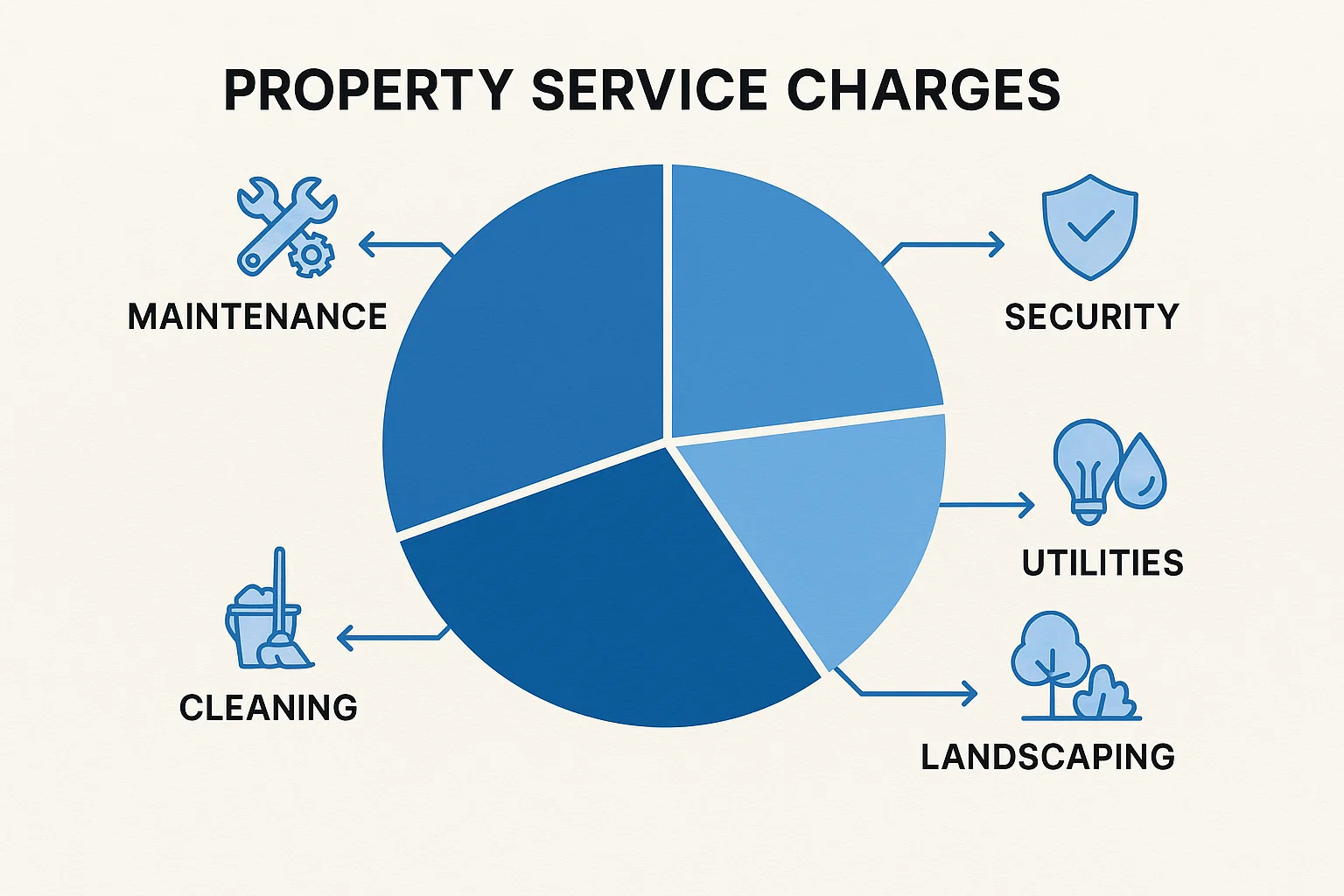
Dubai service charges fund the management, operation, maintenance and repair of shared areas and facilities. They can cover everything from lobby cleaning and building security to lift maintenance, insurance and long-term equipment replacement.
These charges directly affect an owner’s operating costs, rental yield and ability to sell the property. Owners should therefore understand how the charges are calculated, which amounts are approved by the Real Estate Regulatory Agency and what can happen when a bill remains unpaid.
What Are Dubai Service Charges?
Service charges are annual amounts collected from owners to pay for the management and maintenance of jointly owned property.
Under Dubai Law No. 6 of 2019, service charges cover the management, operation, maintenance and repair of common parts.
Common parts may include:
- Entrance areas
- Lobbies
- Corridors
- Elevators
- Staircases
- Building structure
- Shared mechanical systems
- Swimming pools
- Gyms
- Landscaped areas
- Internal roads
- Security systems
- Shared parking areas
- Waste-management facilities
- Common-area air conditioning
- Shared utility infrastructure
The exact facilities included depend on the development’s plans, Building Management Regulation and Master Community Declaration.
What Is Mollak?
Mollak is Dubai Land Department’s regulatory system for jointly owned properties. Its name comes from the Arabic word for owners.
The system monitors:
- Service-charge budgets
- Usage-charge budgets
- RERA approvals
- Management companies
- Property-specific service-charge accounts
- Owner invoices and payments
- Financial records connected to jointly owned property
Mollak helps prevent management entities from collecting unapproved amounts or depositing service-charge payments into unauthorised accounts.
Owners can access the Mollak service-charge system to review information associated with their properties.
Who Regulates Service Charges in Dubai?
The Real Estate Regulatory Agency, part of Dubai Land Department, regulates service and usage charges for jointly owned property.
A developer, management company or other management entity cannot decide on a fee and collect it without RERA approval.
Before approving the annual budget, RERA may review:
- The detailed operating budget
- Proposed maintenance costs
- Management fees
- Insurance expenses
- Utility bills
- Service contracts
- Supplier quotations
- Reserve-fund requirements
- Master-community costs
- Previous income and expenditure
DLD’s service and usage charge approval process requires management entities to submit a detailed budget, supporting service contracts and at least three tenders for relevant service providers.
The budget must also be reviewed by a certified audit firm recognised by RERA.
Can a Management Company Collect Unapproved Charges?
A management entity should not demand service or usage charges before obtaining the required RERA approval.
Dubai Land Department states that management entities must not request payment of unapproved service charges. RERA may also approve a temporary budget where necessary while the final annual budget is being completed.
Before paying an invoice, owners should verify:
- The project name
- Budget year
- Unit information
- Approved rate
- Chargeable area
- Payment account
- Management entity
- Invoice period
- Mollak reference
An invoice issued by the building manager is not enough by itself. The amount should correspond with the budget approved through RERA and Mollak.
What Is the Difference Between Service Charges and Usage Charges?
The terms are connected but have different legal meanings.
| Charge | General purpose |
|---|---|
| Service charge | Managing, operating, maintaining and repairing common parts within jointly owned property |
| Usage charge | Managing, operating, maintaining and repairing common facilities within a master project |
Service charges
Service charges usually relate to the shared parts of a particular building or jointly owned project.
Examples include:
- Lift maintenance
- Lobby cleaning
- Building security
- Swimming-pool maintenance
- Common electricity
- Building insurance
- Facilities-management contracts
Usage charges
Usage charges generally relate to facilities serving a wider master community.
Examples may include:
- Master-community landscaping
- Main community roads
- Shared parks
- Community security
- Major public facilities
- Master-development infrastructure
An owner may therefore receive charges connected to both the individual building and the wider master community.
What Do Dubai Service Charges Cover?
The annual budget may contain several cost categories.
Cleaning and housekeeping
This can include cleaning:
- Lobbies
- Corridors
- Elevators
- Shared washrooms
- Parking areas
- Swimming-pool surroundings
- Other common facilities
Security and safety
Costs may include:
- Security guards
- CCTV monitoring
- Access-control systems
- Fire-safety systems
- Emergency equipment
- Safety inspections
Repairs and maintenance
This category may cover:
- Elevators
- Pumps
- Shared plumbing
- Electrical systems
- Common air-conditioning systems
- Swimming pools
- Gym equipment
- External lighting
- Building façades
- Internal roads
Common-area utilities
The budget may include electricity, water or cooling used in shared areas. Utility consumption inside an individual apartment or unit is generally separate.
Insurance
Service-charge funds may be used for insurance covering the jointly owned property and common parts.
This does not necessarily replace an individual owner’s contents, landlord or unit-specific insurance.
Management and administration
The budget can include RERA-approved management-company fees, financial administration and other approved project-management expenses.
Auditing
Service-charge accounts and annual budgets are subject to financial review. The cost of recognised audit services may be included in the approved budget.
Reserve fund
A portion of the budget may be placed into a separate cash reserve for emergency expenses or future replacement of major shared equipment.
The reserve fund can help finance expensive projects such as:
- Lift replacement
- Major roof repair
- Façade restoration
- Central cooling replacement
- Pump replacement
- Fire-system upgrades
- Major structural work
What Service Charges Do Not Normally Cover
Service charges generally relate to common property rather than repairs entirely inside an owner’s unit.
They do not usually cover:
- Internal painting
- Appliances inside the unit
- Tenant-caused damage
- Internal furniture
- Personal contents
- Unit-specific utility consumption
- Mortgage payments
- Property management for an individual landlord
- Leasing commission
- Ejari fees
- Repairs that are solely the unit owner’s responsibility
Responsibility can depend on the property plans, Building Management Regulation and the cause of the problem. For example, a leaking pipe may serve only one unit or form part of the shared building system.
Who Must Pay Service Charges?
The property owner is legally responsible for paying approved service and usage charges.
A tenancy contract may state that the tenant will pay some or all of these amounts. However, Article 16 of Law No. 6 of 2019 provides that the owner remains liable if the tenant fails to pay.
This means a landlord cannot rely only on a clause saying that the tenant is responsible. If the tenant defaults, the management entity can still pursue the registered owner.
The owner can then consider enforcing the tenancy agreement against the tenant through the appropriate legal process.
Can a Tenant Be Asked to Pay Service Charges?
The tenancy agreement can allocate service or usage charges to the tenant. However, landlords should make this clear before the lease is signed.
The contract should identify:
- Which charges the tenant must pay
- Which charges remain with the owner
- How invoices will be provided
- The payment deadline
- What happens if the tenant fails to pay
- Whether common-area cooling is included
- Which unit-specific utilities are separate
Even when the tenant has agreed to pay, the owner should monitor the Mollak account. The owner remains responsible to the management entity if the tenant does not settle the approved amount.
How Are Dubai Service Charges Calculated?
An owner’s share is generally calculated using the area of the unit recorded in the Real Property Register and the applicable RERA-approved rate.
A simplified calculation is:
Suppose:
- Approved service-charge rate: AED 18 per square foot
- Unit area on the relevant property record: 1,000 square feet
The simplified annual charge would be:
However, an actual invoice may include several approved components. Different rates or allocation methods may apply to building services, master-community charges, reserve funds or different property uses.
Owners should therefore use the official index and invoice rather than relying only on a single headline rate.
Is the Charge Based on Internal Living Space?
The legally relevant area is generally the unit area recorded in the Real Property Register.
This may not always match:
- The area shown in a marketing brochure
- The owner’s estimate of usable space
- The internal living area
- The area stated on an online property listing
Owners should compare the invoice against their title deed and DLD property records. If the area appears incorrect, the issue should be raised with the management entity and Dubai Land Department.
Why Do Service Charges Differ Between Buildings?
Two apartments of the same size can have very different annual charges.
Rates may be affected by:
- Number of units
- Building age
- Number of elevators
- Swimming pools
- Gym and leisure facilities
- Concierge services
- Landscaping
- Security requirements
- Cooling systems
- Maintenance contracts
- Insurance costs
- Energy efficiency
- Master-community charges
- Reserve-fund needs
- Quality of construction
- Previous maintenance delays
A development with extensive amenities may cost more to operate. However, a high rate does not automatically mean the property is well managed. Owners should examine service quality, budget details and maintenance history.
How to Check Approved Dubai Service Charges
Dubai Land Department provides a free Service Charge Index for jointly owned properties.
The DLD Service Charge Index can be accessed through:
- The DLD website
- Mollak
- Dubai REST
Owners can search using information such as:
- Title deed number
- Project name
- Master community
- Property group
- Property usage
- Budget year
- Property location
The service provides immediate access to the approved information available for the selected property and year.
A property owner should:
- Open the DLD Service Charge Index.
- Select the relevant search method.
- Enter the project or title deed information.
- Choose the correct budget year.
- Select the property usage.
- Review the approved rate.
- Compare it with the management company’s invoice.
- Contact the management entity if there is a discrepancy.
How Are Service Charges Paid?
Dubai Land Department states that owners should pay service charges into accounts approved by RERA.
Mollak may send an email or SMS containing payment information. Owners should use the approved payment channels stated in the official invoice or Mollak notification.
Payments should not be sent to:
- A broker’s personal account
- An employee’s account
- An unrelated developer account
- An unverified payment link
- A cash collector without proper authority
The management entity must maintain a dedicated service-charge account for the jointly owned property with a bank licensed in Dubai and recognised by RERA.
Under Law No. 6 of 2019, collected service charges must generally be deposited into the approved account within seven working days.
How Service-Charge Funds Can Be Used
Service-charge money cannot be freely used for unrelated developer or management-company expenses.
The law limits its use to approved purposes such as:
- Cleaning
- Security
- Safety services
- Common-part maintenance
- Repairs and improvements
- Insurance
- Auditing
- Approved management fees
- Approved administrative costs
- RERA inspections and oversight
- Emergency reserves
- Equipment replacement
- Other RERA-approved common-property expenses
The funds in the account are also protected from claims made by creditors of the management entity.
What Is the Reserve Fund?
The reserve fund is money set aside for future major repairs, emergency work and replacement of shared assets.
It is different from the day-to-day operating budget.
For example, routine lift servicing may be paid from the annual operating budget. Full lift replacement several years later may be paid from the reserve fund.
Law No. 6 of 2019 requires the cash reserve to be held separately. It should not be used for purposes other than qualifying emergencies without RERA approval.
If the reserve is insufficient for an urgent expense, Dubai Land Department may, subject to RERA approval, request additional contributions from owners.
Can Owners Ask to See the Budget?
Owners can request information about the approved charges and compare the invoice with the Service Charge Index.
An Owners Committee has a more formal role. Under Article 24 of Law No. 6 of 2019, the committee may:
- Review annual maintenance budgets
- Request financial reports
- Submit recommendations
- Raise maintenance concerns
- Receive complaints from owners and occupants
- Escalate unresolved issues to RERA
- Report structural or common-area defects
The committee does not independently operate the service-charge account. Its role is primarily oversight, communication and recommendations within the framework established by RERA.
What Happens If You Do Not Pay Service Charges?
Ignoring approved service charges can have serious consequences.
The management entity can place a lien on the unit
Law No. 6 of 2019 gives the management entity a lien over a unit for unpaid charges.
The unit may not be sold or transferred
The law states that a unit cannot be disposed of until the outstanding service charges have been paid.
This can delay:
- Sale registration
- Ownership transfer
- Developer or management NOCs
- Other property transactions
The owner receives a payment notice
The management entity must request payment through a written notice approved by RERA. The owner is generally given 30 days from service of the notice to settle the amount.
The claim can become enforceable
If the owner does not pay within the notice period, the management entity’s financial claim may be enforced through the Rental Disputes Settlement Centre.
The unit may ultimately be sold by public auction
Where necessary, an execution judge may order the property to be sold by public auction to recover unpaid charges.
The owner may face additional costs
A defaulting owner may also be required to pay court expenses, enforcement costs and legal fees awarded by the execution judge.
Can a Management Company Block Access Over Unpaid Charges?
A developer or management entity cannot simply prevent an owner from taking possession of or using their unit, common parts or common facilities as an informal method of forcing payment.
Article 29 of Law No. 6 of 2019 requires the management entity to follow the legal collection procedure.
This does not remove the owner’s obligation to pay. The management entity can still issue the approved notice, enforce its lien and pursue the debt through the Rental Disputes Settlement Centre.
Can an Owner Refuse to Pay Because Services Are Poor?
An owner should not simply stop paying a RERA-approved charge because they are dissatisfied with cleaning, maintenance or building management.
Article 28 of Law No. 6 of 2019 states that an owner may not refuse to pay approved service or usage charges. An owner also cannot give up their interest in the common parts to avoid payment.
Instead, the owner should:
- Document the service failure.
- Notify the management entity in writing.
- Request a written response and corrective action.
- Contact the Owners Committee.
- Check the approved budget through Mollak.
- Submit the appropriate complaint to RERA or DLD.
- Seek legal advice if the dispute involves a significant amount.
Owners should keep photographs, emails, invoices and maintenance records supporting the complaint.
How to Challenge an Incorrect Service-Charge Invoice
If an invoice appears incorrect, first determine whether the problem involves:
- An unapproved rate
- The wrong budget year
- Incorrect unit area
- Duplicate billing
- A payment not credited
- Incorrect property usage
- An unauthorised additional fee
- A charge already paid by a previous owner
- A calculation error
- A service not included in the approved budget
Then:
- Compare the invoice with the DLD Service Charge Index.
- Collect the title deed and previous receipts.
- Request an account statement.
- Write to the management entity.
- Ask for the RERA approval reference.
- Submit the enquiry through Mollak if unresolved.
- Use the DLD complaint channel where appropriate.
- Escalate a financial enforcement dispute to the competent authority.
The Mollak enquiry service supports parties dealing with jointly owned properties.
Service Charges When Buying a Dubai Property
Buyers should investigate service charges before signing a sale agreement.
Ask for:
- Current approved rate
- Previous years’ rates
- Latest service-charge invoice
- Proof of payment
- Account statement
- Outstanding balance
- Reserve-fund information
- Planned major works
- Management-company details
- Owners Committee information
- Building maintenance history
A low purchase price may be less attractive if the development has high recurring charges or requires major repairs.
Buyers should also confirm who will settle any outstanding amount before transfer. Because unpaid charges can create a lien and restrict disposal of the unit, this should be resolved in the sale documents.
Service Charges When Selling a Property
Before listing or transferring a property, the owner should:
- Request an updated account statement.
- Pay outstanding approved charges.
- Keep all receipts.
- Check for uncredited payments.
- Obtain any required clearance or NOC.
- Agree on the treatment of prepaid charges.
- Include service-charge adjustments in the sale agreement.
Where annual charges have been paid in advance, the buyer and seller may agree to apportion the cost based on the completion date.
How Service Charges Affect Rental Yield
Service charges are one of the largest recurring expenses affecting net rental returns.
Gross yield is calculated as:
Net yield takes ownership costs into account:
Suppose:
- Property value: AED 1,500,000
- Annual rent: AED 105,000
- Service charges: AED 18,000
- Other annual costs: AED 7,000
Gross yield:
Net yield:
An investor comparing properties should therefore examine net income rather than annual rent alone.
How Owners Can Control Service-Charge Risk
Individual owners cannot unilaterally set the service-charge rate, but they can reduce risk by:
- Checking the Service Charge Index annually
- Monitoring Mollak notifications
- Paying only into approved accounts
- Keeping payment receipts
- Reviewing budget information
- Reporting maintenance failures promptly
- Participating in the Owners Committee
- Monitoring planned major works
- Comparing annual increases
- Checking reserve-fund adequacy
- Updating contact information with the management company
- Investigating charges before buying
Active owners are better positioned to identify incorrect invoices and poor building management early.
Common Dubai Service-Charge Mistakes
Property owners should avoid:
- Assuming all buildings charge the same rate
- Using the brochure area instead of official property records
- Paying an unapproved invoice
- Sending money to an unverified account
- Ignoring Mollak notifications
- Assuming the tenant’s contractual obligation releases the owner
- Stopping payment because of poor service
- Failing to obtain receipts
- Ignoring outstanding balances during a sale
- Confusing unit utilities with common-area utilities
- Treating reserve-fund contributions as an unnecessary extra
- Calculating rental yield without service charges
- Waiting until a property transfer to resolve account errors
Frequently Asked Questions
Are service charges compulsory in Dubai?
Yes. Owners of units in jointly owned developments must pay service and usage charges approved by RERA.
How often are service charges paid?
They are annual charges, but the management entity may invoice owners annually, quarterly or according to another approved payment schedule.
Can service charges increase every year?
The approved amount can change when operating costs, insurance, maintenance contracts, utilities, reserve needs or other project expenses change. The new annual budget must follow RERA’s approval process.
Can owners negotiate the service-charge rate?
An individual owner cannot privately negotiate a separate rate. Owners and Owners Committees may review budgets, raise concerns and make recommendations, but RERA approves the applicable charges.
Does the developer pay charges for unsold units?
Law No. 6 of 2019 requires the developer to pay its share for unsold units. The developer must also pay for sold units where it has contractually undertaken to cover the charges on behalf of purchasers.
Are tenants responsible for service charges?
The lease can require the tenant to pay, but the registered owner remains liable to the management entity if the tenant defaults.
Do service charges include district cooling?
Common-area cooling costs may form part of approved service charges. Unit-specific district-cooling consumption or capacity charges may be billed separately, depending on the project and utility arrangements.
Can unpaid service charges stop a property sale?
Yes. The management entity has a lien for unpaid approved charges, and the unit may not be disposed of until the debt is settled.
Where can owners complain?
Owners should first contact the management entity and Owners Committee. Unresolved issues can be raised through Mollak, Dubai REST or the relevant DLD complaint channel.
Final Thoughts
Dubai service charges are a significant part of property ownership and should be assessed before buying, renting out or selling a unit.
Owners should verify that every invoice matches the RERA-approved budget, use the DLD Service Charge Index and pay only through accounts approved in Mollak. They should also understand that assigning charges to a tenant does not remove the owner’s ultimate liability.
Unpaid charges can lead to a lien, restrictions on selling the unit, enforcement proceedings and, in serious cases, a court-ordered public auction. At the same time, management entities must follow the law and cannot collect unapproved amounts or use informal restrictions to force payment.
HAMZ provides practical Dubai property guidance to help owners, landlords, buyers and investors understand ownership costs, evaluate net returns and make better-informed real estate decisions.